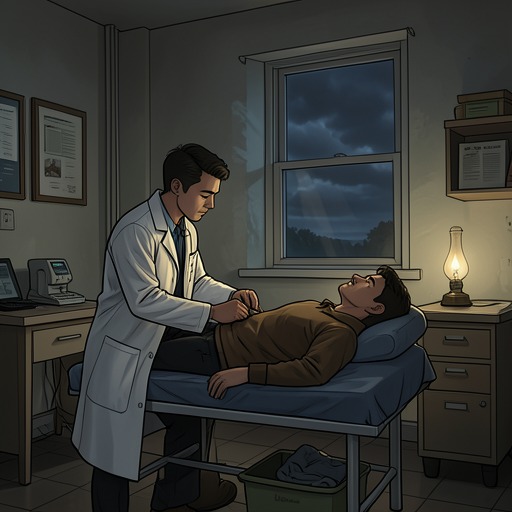
The New Dachang outbreak
World War ZThe New Dachang outbreak is the narrator’s first direct encounter with the plague and the moment when an apparently obscure medical emergency becomes unmistakably political. In a remote hamlet rebuilt after the flooding and destruction of Old Dachang, seven villagers lie sick in a locked communal hall, bearing human bite wounds; within hours, armed state forces arrive in hazardous-materials suits, remove the patients in restraints, take the boy away in a body bag, and subject the entire village to examination. The outbreak therefore establishes the plague not only as a biological crisis but also as an emergency through which the state claims absolute control over vulnerable lives.
A Rebuilt Village and a Buried Past
New Dachang is not an ordinary town. Old Dachang had existed since the period of the Three Kingdoms, surrounded by farms, houses, and trees said to be centuries old. When the Three Gorges Dam was completed and the reservoir rose, much of the settlement was dismantled brick by brick and reconstructed on higher ground. The rebuilt site became a national historic museum rather than a living town, leaving local peasants able to visit their former home only as tourists. The hamlet’s name preserves a connection to that displaced heritage, making the outbreak unfold within a landscape already shaped by state modernization, forced relocation, and historical loss.
The location also carries an atmosphere of political and cultural contradiction. The surrounding region had once contained more than thirty-five million people, but after the war barely fifty thousand remained. Reconstruction funds were slow to reach the area because the government favored the densely populated coast. There was no central power grid and no running water apart from the Yangtze River, yet the streets had been cleared of rubble and a local security council had prevented postwar outbreaks. Its chairman, Kwang Jingshu, was an elderly medical doctor with wartime injuries who still made house calls. Against this background, the New Dachang outbreak appears as both a failure of national protection and a test of locally maintained order.
The First Clinical Signs
The narrator receives the call during a quiet hospital shift, after a night increasingly marked by motorcycle accidents. A new receptionist struggles with the local dialect, but the urgency is clear: an accident or illness requires immediate assistance. At the meeting hall, the narrator finds seven people lying on cots, barely conscious, in a cold, damp room of bare cement. The villagers have refused to care for them because it is not safe, have locked the door from the outside, and keep their distance while cringing, whispering, and praying.
The first patient is a woman with a fever of forty degrees centigrade, violent shivering, and barely coherent speech. Her right forearm bears a bite mark. The injury is unusually clean, but its radius and tooth impressions indicate that it was inflicted not by an animal but by a small or possibly young human being. The narrator initially considers the wound a possible source of infection, yet its lack of inflammation creates an immediate medical puzzle: without anyone cleaning it, why has it not become infected by the bacteria normally present in the human mouth?
The six other patients display the same general symptoms and similar wounds on different parts of their bodies. The most lucid man explains that the injuries occurred when the group tried to subdue “him.” The singular pronoun suggests that the patients’ condition began with an encounter involving one violently transformed individual, while the repeated wounds show how quickly such an encounter could spread danger through a small community. The outbreak’s horror is consequently introduced through clinical observation before it is fully named: fever, incoherence, restraint, and the unmistakable evidence of human teeth.
Containment as State Violence
The narrator contacts a superior and shows him the patients through a phone camera, bringing the device close to the wounds at his request. The video connection is then cut. The superior orders the narrator to remain in place, identify everyone who has had contact with the infected, restrain those already infected, and clear and secure the room if anyone has entered a coma. He also asks whether the narrator is armed, a question that transforms the scene from medical treatment into a security operation. Support is promised within several hours.
The response arrives in less than an hour: fifty men in large army Z-8A helicopters, all wearing hazardous-materials suits. They claim to represent the Ministry of Health, but the narrator recognizes them as the Guoanbu from their bullying swagger and intimidating arrogance. The official label of public health conceals an intelligence and coercive apparatus. Their speed, equipment, and numbers demonstrate that the state can reach even this isolated village when it is protecting itself from contagion, although it has been much slower to deliver electricity, water, and reconstruction funds.
The patients are removed first. They are carried out on stretchers with their limbs shackled and their mouths gagged, treated as containment threats rather than as citizens requiring care. The boy is brought out in a body bag. His mother’s wailing accompanies the roundup of the rest of the village, whose residents are subjected to blood draws, identification, stripping, and photographic documentation under the heading of “examinations.” The outbreak thus reveals an emergency regime in which ordinary distinctions between patient, suspect, witness, and enemy collapse.
Memory, Superstition, and Foreknowledge
The final villager to be exposed is a withered old woman whose body bears the marks of age and of bound feet. Shaking her fist at the officials, she declares that the outbreak is punishment and revenge for Fengdu, the City of Ghosts. Fengdu’s temples and shrines were devoted to the underworld, but the city, like Old Dachang, was treated as an obstacle to China’s next Great Leap Forward: it was evacuated, demolished, and almost entirely drowned.
The narrator rejects the old woman’s supernatural interpretation. As a doctor and scientist, the narrator claims to believe only in what can be seen and touched and dismisses Fengdu as a cheap tourist attraction. Yet the dismissal does not erase the force of her anger. She has lived through warlords, the Japanese invasion, and the nightmare of the Cultural Revolution; her knowledge is not scientific, but it is historical and experiential. The narrator concludes that she recognizes another storm approaching even without the education to explain it. Her speech therefore becomes a form of accidental foresight, joining local memory to the outbreak’s modern epidemiological reality.
Narrative Significance and Wider Reverberations
The New Dachang outbreak is framed as a local incident, but its implications extend across the wider plague narrative. The narrator’s first-hand discovery of a human bite and the subsequent military response anticipates later confusion over reports from mainland China. Jurgen Warmbrunn recalls receiving badly decoded messages from PRC sources describing a virus that killed victims and reanimated their corpses into homicidal berserkers. He initially treats the reports as a coded weapon system or secret war plan, especially after the Taiwan Strait crisis interrupts the messages. The New Dachang scene supplies the concrete reality that those distant communications obscure.
The event also clarifies why information fails at the beginning of the crisis. Authorities do not merely lack knowledge; they filter, encrypt, suppress, or militarize it. Later, media organizations cover up the outbreak without needing direct coercion because another panic would damage their corporate interests, while Phalanx makes the disease appear manageable and the public grows tired of hearing that the dead are walking. In contrast, the New Dachang villagers encounter the crisis before it can be converted into a reassuring story. Their locked hall, whispered prayers, and forced examinations preserve the raw physical intensity of the first contact.
Finally, the outbreak establishes a pattern repeated throughout the war: human institutions respond to biological and ecological upheaval by reorganizing bodies, animals, machines, and information into systems of survival. Military dogs are later trained to identify infection, escort long-range patrols, and confront feral packs; F-lions and other altered predators expose the ecological consequences of the collapse; whales become casualties when navies and refugee fleets turn to industrial hunting. Against those later global transformations, New Dachang remains the intimate prototype: one bite, seven patients, one terrified community, and a state that arrives not as a healer but as an armed force claiming the right to decide who may be treated, restrained, photographed, or removed.